
Advanced Energy Materials
26 April 2024
Upgrading Cycling Stability and Capability of Hybrid Na-CO2 Batteries via Tailoring Reaction Environment for Efficient Conversion CO2 to HCOOH
Xiecheng Yang1,2,†, Dantong Zhang3,†, Lanqing Zhao1,2, Chao Peng3, Kun Ren1,2, Changfan Xu4, Pan Liu1,2, Yingjie Zhou1,2, Yong Lei4, Bin Yang1,2, Dongfeng Xue5, and Feng Liang1,2,6,*
1 Faculty of Metallurgical and Energy Engineering, Kunming University of Science and Technology, Kunming, 650093 China
2 National Engineering Research Center of Vacuum Metallurgy, Kunming University of Science and Technology, Kunming, 650093 China
3 Multiscale Crystal Materials Research Center, Shenzhen Institute of Advanced Technology, Chinese Academy of Sciences, Shenzhen, 518055 China
4 Fachgebiet Angewandte Nanophysik, Institut für Physik & IMNMacroNano, Technische Universität Ilmenau, 98693 Ilmenau, Germany
5 Shenzhen Institute for Advanced Study, University of Electronic Science and Technology of China, Shenzhen, 518110 China
6 Key Laboratory for Nonferrous Vacuum Metallurgy of Yunnan Province, Kunming University of Science and Technology, Kunming, 650093 China
† X.Y. and D.Z. contributed equally to this work.
10.1002/aenm.202304365
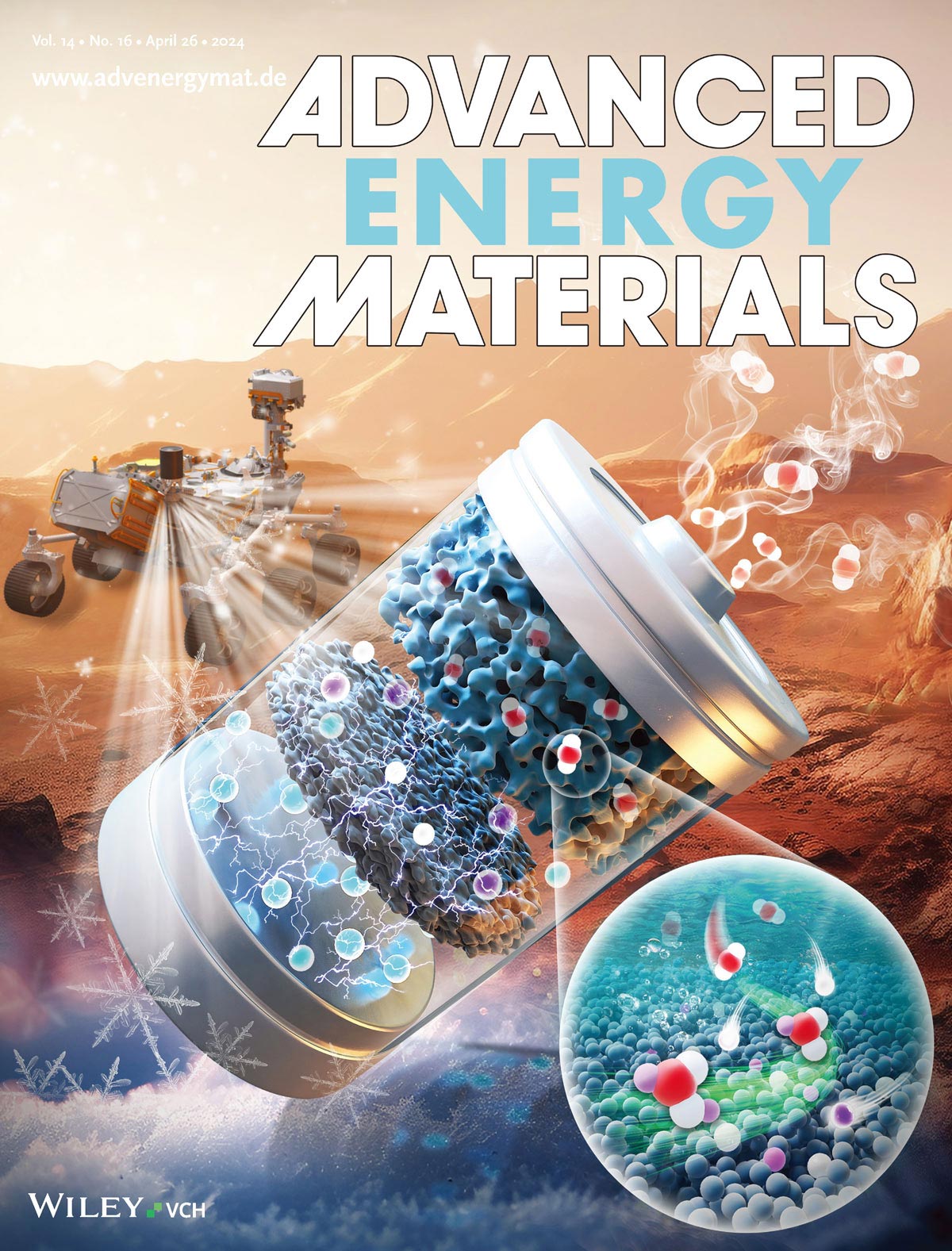
In the article number 2304365, Feng Liang and co-workers controlled the relative concentration of H/O atoms at the catalyst/electrolyte interface by designing the electrolyte and establishing a reaction environment conducive to the generation of HCOOH. The hybrid Na-CO2 battery, based on the discharge product of HCOOH, exhibits an ultra-high discharge specific capacity and excellent cycle reversibility, especially low-temperature cycle stability.
Anhui Province Academy of Science and Technology, No. 128,Wanshui Road, Hi-Tech Zone, Hefei City, Anhui Province, China
 +86 17354022649
 service@sondii.com


영업 시간
11월 21일 월요일 - 11월 23일 수요일: 오전 9시 - 오후 8시
11/24 목요일: 휴무 - 즐거운 추수감사절 보내세요!
11월 25일 금요일: 오전 8시 - 오후 10시
11월 26일 토요일 - 11월 27일 일요일: 오전 10시 - 오후 9시
(모든 시간은 동부 표준시 기준)
 IPv6 네트워크 지원